
Key takeaways
- Express eLearning by Neovation builds one course for a flat $1,999 in about 10 business days (up to an hour of seat time, up to three modules). A library is that price times the number of courses you need.
- Because the per-course price is flat and known, you can scope an entire library up front and see the total before you commit. A first library usually runs a dozen to two dozen courses, which at $1,999 each comes to roughly $20,000 to $50,000.
- A course library usually stalls for one reason: production. Most associations have the plan and the content; what they lack is anyone on staff with the hours. Naylor's 2025 benchmarking report found 51% of associations understaffed.
- Start with the courses members need anyway: required compliance and continuing education, new-member onboarding, the topics members ask about most, and the conference sessions you have already recorded.
- A flagship certification or a course built on a complex simulation is a genuine custom project, and worth the larger investment when the stakes justify it.
Most small associations have the same folder: recordings from a few conferences ago that nobody has opened, sitting next to a running list of the courses members keep asking for. What they don't have is anyone on staff whose actual job is turning either one into something a member can take. The education director already wears four hats, and there is no learning team and no developer to hand it to.
So the library stays a plan. Every strategy deck says associations should build online courses for non-dues revenue and member value, and that advice is right. The piece nobody hands you is how to get it built when you are three or ten people and none of you builds courses for a living.
This is about the part that actually gets stuck: production. I want to walk through what belongs in a first library, how a flat per-course price lets you build an association course library on a budget you can plan around, and where to start so you get one win before you scale. "Fixed budget" here does not mean cheap. It means a number you can know in advance, which for this kind of work is the harder thing to come by.
Why the course library never gets built
It is almost never a failure of ambition. The plan exists, the content mostly exists, and the people want it. What is missing is anyone with the hours to do the work. In Sequence Consulting's 2026 Association Trends Report, 52% of associations named limited staff capacity as a top hurdle to growing revenue, and Naylor's 2025 benchmarking report found 51% of associations understaffed, with non-dues revenue the top financial challenge three years running. The bottleneck is production, not strategy.
That reframe matters because the two problems have different solutions. If the problem were strategy, you would need a consultant and a planning offsite. It isn't. You already know which courses members want. The association leaders I talk to can usually name five off the top of their head. The catch is that building even one of them properly takes instructional design, development, accessibility work, and SCORM packaging, and none of that fits between renewals season and the annual conference.
So the real question is a practical one: who builds the courses, and what does that cost.
Name the real problem: If you can name the courses members want but none of them exists, you do not have a strategy problem. You have a production problem, and it has a price.
What belongs in your first course library
Start with the courses you would have to produce anyway, plus the ones members are already asking for. That is usually four buckets:
- Compliance and continuing education (CE): the required training your members or their employers need for licensure, certification maintenance, or regulatory reasons. It has a captive audience and a clear reason to exist, which makes it the safest place to start.
- New-member onboarding: the "how this association works and how to get value from it" course. It runs for years, it helps retention, and you only build it once.
- The topics members ask about most: the five or six subjects that come up in every member survey and every conference Q&A. You already know what they are.
- Recorded sessions you already own: conference and webinar recordings are content you have paid for once and used once. The slides and the recording are most of a course already.
You do not need all of this at once. The point of listing it is that the backlog is bigger and more buildable than it feels when it lives as a vague intention. Most of these are standard courses: clear content, a defined audience, a known standard to meet. That is exactly the kind of work a fixed scope handles well.
For the recorded-sessions bucket specifically, it is worth converting properly so the result works as a course members actually finish, which is its own small process. There's a practical guide to converting the training you already have if that is where you want to start.
Start with what already has a reason to exist: Required compliance and CE first, onboarding second, then the most-requested topics. Recorded sessions can become courses on the same budget line. Leave the flagship, high-stakes build for later.
How do you build an association course library on a budget?
You build it at a flat, known price per course, scoped before you start. That is the whole mechanism. Express eLearning by Neovation is a productized eLearning development service: a finished, SCORM-ready course in about 10 business days, for $1,999. Each course covers up to an hour of seat time and up to three modules, and you own the source files. A library is simply that price times the number of courses you decide to build.
Because the price per course does not move, you can scope the entire library up front and see the total before you commit a dollar. That is what makes it a fixed budget in the sense that matters: not a small number, a known one. The Express eLearning pricing calculator prices a single course in about two minutes, so you can multiply it across your list and walk into a board meeting with a real figure instead of a range with a question mark on the end.
Here is what that looks like in practice. Say your first library is fourteen courses: four compliance and CE modules, an onboarding course, and the nine topics members ask about most. At $1,999 each, that is about $28,000 for the set, whether you commission them together or in two or three planned phases. Lists run longer or shorter, and a dozen to two dozen courses puts the total somewhere between $20,000 and $50,000. There is no volume rate and no bulk discount in that math. The predictability is the point. For how eLearning costs break down across other build options, the guide to what eLearning development costs covers it in detail.
What you get for the per-course price is the full build: instructional design, development, quality assurance, a WCAG 2.1 AA accessibility review, and SCORM 1.2 or 2004 packaging, done by Neovation's instructional designers and developers. The result meets the SCORM and accessibility standards members and their employers increasingly expect.
To be really clear about where this stops: a flagship certification, or a course built around a branching simulation where the wrong choice has real consequences, is a genuine custom project. That is Neovation Custom Learning, a different kind of build, and the right call when the cost of getting it wrong is high enough to justify it. The fixed-price model is for the rest of the library, which is most of it.
Scope the whole library before you start: A dozen to two dozen courses at $1,999 each is $20,000 to $50,000, a number you can see up front. Then decide whether to build it in one batch or in planned phases.
What to build first, and what can wait
Build one course before you build twelve. Pick the single course members ask for most, commission it, put it in front of members, and watch what happens. You will learn more from one finished course in members' hands than from another planning meeting. Pick an area, get a win, then scale from there.
There is a sequencing choice underneath this, and it is mostly a cash-flow question. If you can fund the set, commissioning the library in one batch gets everything live faster and gives you a single intake to manage. If the budget has to arrive in stages, phase it: one or two courses a quarter, paid for as non-dues revenue from the first ones starts to come in. Both work. What does not work is waiting until you can do all of it perfectly, because that is how three years go by with the folder still full. Doing anything is better than doing nothing.
A practical order: required compliance and CE first, since it has the clearest mandate and the most reliable audience; onboarding next, because it pays back in retention for years; then the most-requested topics in whatever order the calendar allows. Save any genuine custom build, the flagship certification, for when you have a few wins behind you and a stronger case for the investment.
Pick the one course members ask for most: Build it, ship it, see how it lands. One finished course teaches you more than a year of planning, and it funds the next one.
Where Express eLearning fits an association's library
For the standard courses that make up most of a member library, Express eLearning is built to take the production off your staff. You send a topic, a deck, a recorded session, or a policy document, and the work comes back as a finished, SCORM-ready course in about 10 business days, accessibility reviewed and packaged for whatever learning management system you already use, with the source files yours to keep. The price per course stays put, so you can plan the whole library instead of guessing at it.
Where it is not the fit: a high-stakes flagship program, a major certification or a simulation where a wrong choice has real consequences, is a custom build, and Neovation Custom Learning is the right home for that work. If your association already has its own learning team with the time to build, you may not need outside production at all. For everything in between, which is where most associations actually live, the model is simple enough to start this quarter.
So pick the one course your members keep asking for, and scope the library around it. The point of all this is not the library as a line on a slide. It is the member who finally gets the training they have been requesting for two years, and renews because the association delivered something they could use. Get Started when you want to scope your list.
Frequently Asked Questions
Through Express eLearning by Neovation, a course is a flat $1,999, delivered in about 10 business days, covering up to an hour of seat time and up to three modules. A library is that price times the number of courses you build, so a first library of a dozen to two dozen courses lands in the $20,000 to $50,000 range, depending on how many you scope. There is no bulk rate. The value is that the per-course price is fixed, so you can see the total before you commit.
Yes, and most associations do. Because the per-course price is flat, you can scope the entire library up front and decide whether to commission it in one batch or in planned phases. Buying several courses at once is the normal way associations get to a library.
No. Express eLearning produces the finished courses, and you deliver them on whatever learning management system you already use. The courses are packaged in SCORM 1.2 or 2004 so they load into standard systems, and you own the source files, so you are not locked to any one platform.
No, and the difference is worth being clear about. A flagship certification or a course built around a complex simulation is a genuine custom project, handled by Neovation Custom Learning, and worth the larger investment when the stakes justify it. For the rest of a member library, which is most of it, a flat per-course price gets professional courses built without that level of investment.
Start with the courses that already have a reason to exist: required compliance and continuing education, new-member onboarding, and the handful of topics members ask about most. Recorded conference and webinar sessions you already own are often most of a course already. Build the single most-requested course first, see how members respond, then expand.
Related resources
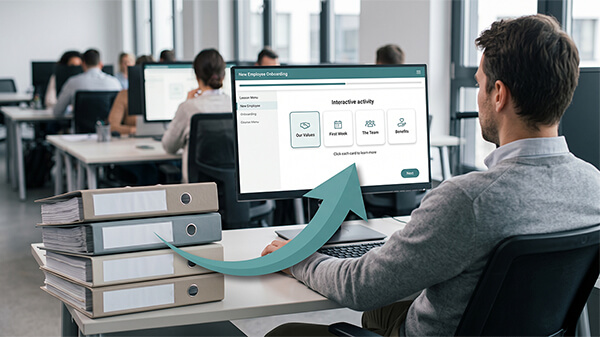
How to digitize corporate training without losing what works
Decide what to convert, rebuild, or retire when modernizing legacy training.

How much does eLearning cost in 2026?
Why eLearning quotes vary 10x, what drives the spread, and how to budget by role.

SCORM compliant courses: what the standards actually require
What SCORM and WCAG compliance mean, what it costs, and how to vet vendor claims.